It’s better to set limits on video games than to ban them outright. Here’s why.
Many children have access to video games from an early age, whether on a cell phone, tablet, computer, or game console. Can video games be educational? What are the risks of these games? And, most importantly, how do you set limits on them?
Additional reading on this topic:
Why set limits on video games instead of banning them?
If your child plays video games, setting limits on their use is the best way to avoid the associated risks and help your child develop healthy screen habits.
By setting limits on video games instead of banning them, you help your child develop self-control. This is important, because as your child gets older, they may be exposed to video games when you aren’t around (for instance, at a friend’s house). The good habits they’ve learned at home can help them manage their video game use more responsibly.
Bear in mind, however, that the best source of stimulation for a child is their interactions with their environment and the people around them. While the virtual world may be appealing to a child, it doesn’t offer the same breadth of experiences as the real world.
Drawing, playing with blocks, doing puzzles, playing with modelling clay, playing with friends, or going outside are all activities you should encourage. Video games are just one activity among many; they should never become the main focus of your child’s day.
Remember that gaming time also counts toward your child’s total screen use for the day (tablet, phone, computer, TV, and game console), which should not exceed the recommended maximum.
Recommendations on screen timeHere are the screen time recommendations issued by the Quebec government and the Canadian Paediatric Society (CPS), broken down by age group. In addition to following these recommendations, parents are encouraged to prioritize educational activities when their children are using screens. - Before age 2: Children this young should not be exposed to TV or any other screens. They can, however, take part in video calls to connect with loved ones.
- Ages 2 to 5: No more than 1 hour of total screen time per day.
- Ages 6 and up: 6- to 12-year-olds should spend no more than 2 hours a day on screens for leisure activities (things other than schoolwork), according to recommendations put forward by the Quebec government. For its part, the CPS makes no screen time recommendations for children over 5. Instead, it emphasizes healthy screen use that doesn’t interfere with children’s schoolwork, physical activity, sleep, or social activities, as these should take priority.
|
Risks associated with video games
Despite the potential educational benefits of video games, it’s still important to carefully monitor and set clear rules around your child’s gaming. Video games have risks and can be harmful to your child’s health and development.
- The passive nature of video games can change the way children play. Their creativity may diminish when they have fewer opportunities to play pretend and make up stories.
- Video games can prevent children from developing physical skills. Time spent in front of a screen is time that isn’t spent on movement and physical activity. Movement they do while gaming is no substitute for the physical activity necessary for their psychomotor development. What’s more, prolonged exposure to video games encourages a sedentary lifestyle and can increase the risk of excess weight and obesity.
Regardless of your child’s age, violent, realistic, and single-player video games are not recommended.
- Video games can interfere with your child’s sleep. The blue light emitted by screens keeps the brain active by reducing levels of melatonin, the hormone that regulates sleep. What’s more, exciting video games such as racing and fighting games stimulate the production of stress hormones. This disrupts sleep. Therefore, it’s recommended to limit the use of screens and video games in the evening and avoid exposing your child to them for at least 1 hour before bedtime.
- Prolonged use of screens, especially to play video games, can weaken the eye muscles, leading to vision problems (e.g., blurred vision, difficulty focusing, dry eyes), fatigue, and headaches. Poor posture when playing video games can also lead to musculoskeletal problems.
- Violent video games can frighten children and encourage violent acts. Violent images can cause anxiety in very young children, because they have difficulty distinguishing between the fictional world of the game and the real world. Studies also show a link between the violence depicted in certain video games and desensitization to violence, as well as an increase in aggressive behaviour among players. A child who is frequently exposed to violent situations, even if they are virtual, may come to see them as normal. This may lead them to believe that violence is an effective solution to a problem. The more realistic a game is, the more your child may identify with the characters and be tempted to imitate them.
- Some video games convey messages that can lead children to develop prejudices and stereotypes, particularly towards women and different cultural communities. Some games also feature stereotyped roles for girls (e.g., hairdressing, fashion, cooking).
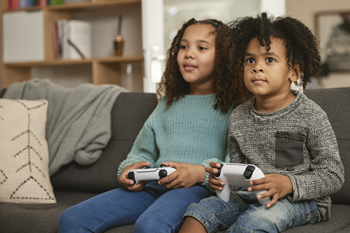
- Playing video games for extended periods drains a child’s dopamine reserve. This can make them less attentive, more emotional, and sometimes even aggressive. Dopamine, also known as the “happy hormone,” is a chemical messenger that plays a role in attention, pleasure, and motivation. When children play video games for a long time, they can end up with a depleted supply. The brain then needs time to replenish its reserves. Going to play outside is a good way to boost dopamine production.
- No matter the type of video game, there is always a risk of developing an addiction. Video games are often designed to manipulate players’ thoughts and emotions, particularly through rewards that keep them wanting more and make it hard to stop. Rewards lead to dopamine boosts and increase the likelihood of addiction. The child’s brain becomes accustomed to this massive dose of dopamine and demands more and more. Eventually, it needs even more dopamine to feel pleasure, and anything that isn’t hyper-stimulating, like video games, becomes boring.
- Many free mobile games expose children to gambling through the use of symbols associated with casinos or games of chance (roulette, slot machines, etc.). This increases the risk of developing a gaming habit and encourages your child to make purchases to get more rewards.
- Video games can shorten children’s attention span and affect their mental health. These games are so engaging that they quickly drain kids’ ability to stay attentive and focused. Children who become addicted to video games may also experience anxiety and depression if they face setbacks or are unable to complete a level. Studies have also linked excessive video game use to worsening ADHD symptoms in some children. What’s more, constantly receiving immediate rewards lowers a child’s tolerance for delays.
- Online games that incorporate user-generated content may expose children to inappropriate content. As this content is not reviewed before it is made visible, it may appear in games initially rated E for everyone.
- Online multiplayer games can encourage bullying. With this type of game, kids are able to communicate with strangers of all ages. Players can talk to one another while they play, and because these conversations are not moderated, they may not be appropriate for kids. For example, people with bad intentions may try to befriend your child. Online bullying can also come from a child or friend playing the same game. It can take many forms, including harassment, threats, spreading rumours, sharing compromising photos, or excluding a child from online groups.
- Free mobile games on phones and tablets expose children to a lot of advertising. Some of these ads promote unhealthy foods and may make them want to eat products that are high in fat, salt, or sugar. Children may also click on ads for games that are inappropriate for them. Ads can also encourage your child to buy things, such as game add-ons.
Tablet drawing games also count as screen timeIf your child enjoys drawing on a tablet, the time they spend on it also counts toward their total daily screen time. Remember that drawing with real materials is the best way to develop their fine motor skills. |
Strategies that get kids hooked on video games
If your child seems obsessed with a video game, it’s not by chance. The game has been designed to keep them hooked. Designers have developed strategies to hold players’ attention for as long as possible, and children’s video games are no exception. Here are three of them.
- Random rewards: Players receive them unexpectedly. They might take the form of confetti, balloons, or coins. Since they are random, they encourage children to keep playing in the hope of getting more.
- Gather quests: The aim is to encourage the child to gather a certain number of items in order to perform an action. For example, gathering keys to open a safe. However, this may become increasingly difficult as the game progresses, and a time limit may also be imposed. If they fail, they may need to wait a certain amount of time before they can restart their quest, which keeps them online for longer.
- Collections: Children are incentivized to use virtual currency to complete a collection of items. A certain item may be especially hard to find, requiring the child to earn more in-game currency to buy it instead. This encourages children to play longer to reach their goal.
Video game addiction: Signs to watch out forBeyond the number of hours spent in front of the screen, certain behaviours are warning signs that may indicate addiction: anxiety, agitation at school, frequent nightmares, and irritability. It’s important to remain attentive to your child’s emotions. |
The benefits of video games
Some types of games may help your child improve certain skills. Here are some of the possible benefits.
- Some video games are designed to teach players about certain concepts or subjects (e.g., colours, numbers, shapes, the alphabet, mathematics, languages).
- Some video games help develop logical thinking, information processing speed, and the visual and spatial skills needed to perceive shapes, sizes, and distances. These latter skills are useful, for example, when putting together a puzzle or understanding how to assemble the pieces of a construction set.
- Slower-paced video games, such as puzzle games or certain mystery games, can improve memory, concentration, and problem-solving skills. As the rules are not written down, the player has to use deduction and creativity to solve problems in a wide variety of situations.
- Video games that require players to complete multiple levels in order to win can encourage perseverance. Studies show an effect on children’s ability to maintain motivation over the long term and to persevere until a task is completed.
- Some multiplayer games, such as puzzle games, can encourage collaboration because they require teamwork and cooperation.
- Some types of video games can help improve the player’s sense of self-efficacy. Video games are far from a solution for self-esteem problems, but they may help a child feel more competent. For example, a child who is less confident in their abilities may feel a sense of accomplishment when they complete a mission or finish a level in the game and develop a more positive self-image as a result.
If your child isn’t interested in video games ...If your child isn’t interested in video games, there’s no need to try to convince them otherwise. Video games are not necessary for their development. They need to play and have experiences in the real world to develop properly. You also don’t need to worry if your child doesn’t use screens before they start school. Children who enter kindergarten with no experience with digital technology easily catch up with their tech-savvy peers. There’s no academic advantage to using screens at a young age. If you want to know more about the skills to work on before kindergarten, read our fact sheet Easing Your Child’s Transition to School. |
Tips for setting limits on video games
If your child enjoys playing video games, you can let them play while minimizing the risks. Here’s how to do it.
- Agree with your child on time limits for their gaming before they pick up the controller. For example, tell them that they have 30 minutes to play their game and no more. Of course, make sure they’re not spending too much time gaming and that they’re engaging in a variety of activities, such as playing with real toys or getting some physical activity in.
- Give your child the opportunity to decide how they’ll manage their gaming time. For instance, give them the option to stop playing a few minutes early, when they’ve finished their mission, or play all the way to the end of their time, knowing that they’ll have to stop in the middle of what they’re doing. You can negotiate with them, for example: “If you stop playing 4 minutes early, before you start a new round, you can add those 4 minutes to your next gaming session.”
- Ask your child if they’d like a heads up a few minutes before their gaming time is over or only right when they need to wrap up. Some children like to be warned ahead of time. Others feel like they’re under pressure and have to make the most of the few minutes they have left. It depends on your child.
- Help your child develop self-control if they get frustrated when they have to stop playing. However, if their behaviour doesn’t improve despite your help, you may need to consider the possibility that they aren’t emotionally mature enough to play video games. Video games are privileges, not necessities. A child who can’t handle frustration, even with coping strategies, shouldn’t have access to them.
- Learn about the content in your child’s video games to make sure they are appropriate not only for their age but also for their maturity level. Don’t go by the age rating on the games. It doesn’t take into account the child’s stage of development or the use of strategies borrowed from gambling and money based games. Play the game yourself so you can thoroughly assess it. Note that console video games can be borrowed from libraries if you want to try before you buy.
- Make sure that game content also reflects your values. For example, choose games that expose your child to diversity and teach respect for others. Talk to the staff at video game stores to check whether the games your child is interested in are suitable for them.
- Encourage your child to explore different types of games (educational, adventure, strategic, simulation) to develop a variety of skills and interests.
- Be mindful of advertising in mobile games. Warn your child not to click on ads or buy anything without talking to you first. Paid games have fewer ads.
- Adjust your device and game settings to block ads and pop-ups on your computer, for example. If your child plays on your phone, make sure they can’t make online payments (e.g., with a credit card, PayPal, or Apple Pay).

- Supervise your child’s conversations with other players if they are playing online.
- Take an interest in your child when they’re playing a video game. Talk to them about what they like about the game. You can also play with them as a way to bond.
- Avoid using video games to keep your child busy or calm them down when they’re bored, annoyed, or frustrated. This can lead to them becoming withdrawn and prevents them from learning to tolerate or find solutions for discomforts like boredom and frustration. It may also get them in the habit of using screens to manage their emotions.
- Do not allow screens or video game consoles in your child’s bedroom. In addition, don’t let them play games alone in their bedroom on a phone or tablet. Instead, make sure they play in a more central location in your home (e.g., the living room or playroom). This way, your child doesn’t have to isolate themself to do their hobby, and you can keep an eye on the type of games they like to play.
- Watch for changes in your child’s behaviour. If they start acting more irritable, nervous, or withdrawn, take the time to understand what they’re going through and figure out what’s at the root of the issue so you can address it.
- Avoid being too critical of video games. Rejecting these activities out of hand means rejecting a part of the world your child is growing up in. This can be hurtful or humiliating for your child and cause them to withdraw.
The North American video game industry has adopted a rating system overseen by the Entertainment Software Rating Board (ESRB). Gaming companies are not obliged by law to use this rating system, but do so voluntarily. The video game’s ESRB rating can give you a general idea of its content. |
- Children and adults
- E (everyone) means that the content is generally suitable for all ages. It may contain minimal cartoon, fantasy or mild violence, or infrequent use of mild language.
- The E10+ rating indicates that the content is generally suitable for children aged 10 and over. It may contain more cartoon, fantasy or mild violence, mild language, or minimal suggestive themes.
- Other ratings
- T (teen) for ages 13 and up.
- M (mature) for ages 17 and up.
- Ao (adult only) for adults only.
|
As there is no law governing this rating system, your child can buy, borrow, or download games even if they are under the age required by the ESRB to play it, without any legal consequences. As a result, it is strongly recommended to monitor you child’s purchases, downloads, and rentals. In addition, free online games and games available in the Google Play Store or Apple App Store are not required to use this rating system and may use their own. |
Things to keep in mind
-
It’s better to set rules around video games than to ban them so your child can develop good screen habits.
-
While video games can be educational, they also have a number of risks, such as physical inactivity, addiction, and desensitization to violence. Prioritize screen-free activities with your child.
-
Learn more about the content of the games your child is interested in and try them out to see if they’re appropriate for their age and align with your values.
Photos: GettyImages/MilicaStankovic, Anna Frank and Miljan Živković
Resources and references-
Bonenfant, Maude, and Alexandra Dumont. “Les mécaniques de jeux de hasard et d’argent dans les jeux mobiles gratuits pour les enfants : d’un modèle économique au conditionnement à l’addiction.” Drogues, santé et société.drogue-sante-societe.ca
-
Briceño, C., and M.-C. Dugas. Parents dans un monde d’écrans. Les Éditions de l’Homme, 2019, 256 pp.
-
cyberdependance.ca. cyberdependance.ca
-
Digital Wellness Lab. digitalwellnesslab.org
-
Encyclopedia on Early Childhood Development. “Technology in early childhood education.” child-encyclopedia.com
-
Gouvernement du Québec. “Balanced screen use for children and teens.” Gouvernement du Québec. 2025. quebec.ca
-
Granic, Isabela, et al. “The benefits of playing video games.” American Psychological Association, vol. 69, no. 1, January 2014, pp. 66–78. apa.org
-
Media Smarts. Canada’s Centre for Digital Media Literacy. mediasmarts.ca
-
Hébert, Ariane. Les effets des jeux vidéo racontés aux enfants. Boucherville, Éditions de Mortagne, 2023, 56 pp.
-
Institut national de santé publique du Québec. Exposition des jeunes à la violence dans les jeux vidéo et les médias sociaux : considérations dans le contexte de la COVID-19. May 2020. inspq. qc.ca
-
JE(UX). Information about free mobile games for children. jeuxmobiles.homoludens.ca
-
Lopez-Fernandez, O., et al. “Video game addiction: Providing evidence for Internet gaming disorder through a systematic review of clinical studies.” European Psychiatry, vol. 33, March 2016, p. S306. www.sciencedirect.com
-
Malboeuf, Marie-Claude. “Jeux mobiles pour les petits : des casinos pour enfants.” La Presse +, October 11, 2023. lapresse.ca
-
PAUSE. “Jeux mobiles gratuits : comment protéger votre enfant.” pausetonecran.com
-
Radio-Canada OHdio. “Parents Wi-Fi : le potentiel des jeux vidéo.” May 2024. ici.radio-canada.ca (podcast)
-
Raiding Children Network. “Video games for kids.” www.raisingchildren.net.au
-
Canadian Society for Exercise Physiology. “Canadian 24-hour movement guidelines: An integration of physical activity, sedentary behaviour, and sleep.” csepguidelines.ca
-
Canadian Paediatric Society. “Screen use and young children.” Caring for Kids. 2022. caringforkids.cps.ca
-
Canadian Paediatric Society. “Screen use and digital media: Advice for parents of school-aged children and teens.” Caring for kids. 2019. caringforkids.cps.ca
-
The Conversation. “Gaming has benefits and perils - parents can help kids by playing with them.” January 2021. theconversation.com
-
Uppsala University. “Tablet computers make preschool childrens play less creative.” 2022. uu.se
The links to other websites are not updated regularly, and some URLs may have changed since publication. If a link is no longer valid, please use search engines to find the relevant information. |